Parametric Cooling.Powered by Nature.
Bridging millennia of ancient architectural wisdom with modern AI, computational fluid dynamics (CFD), and robotic clay printing.
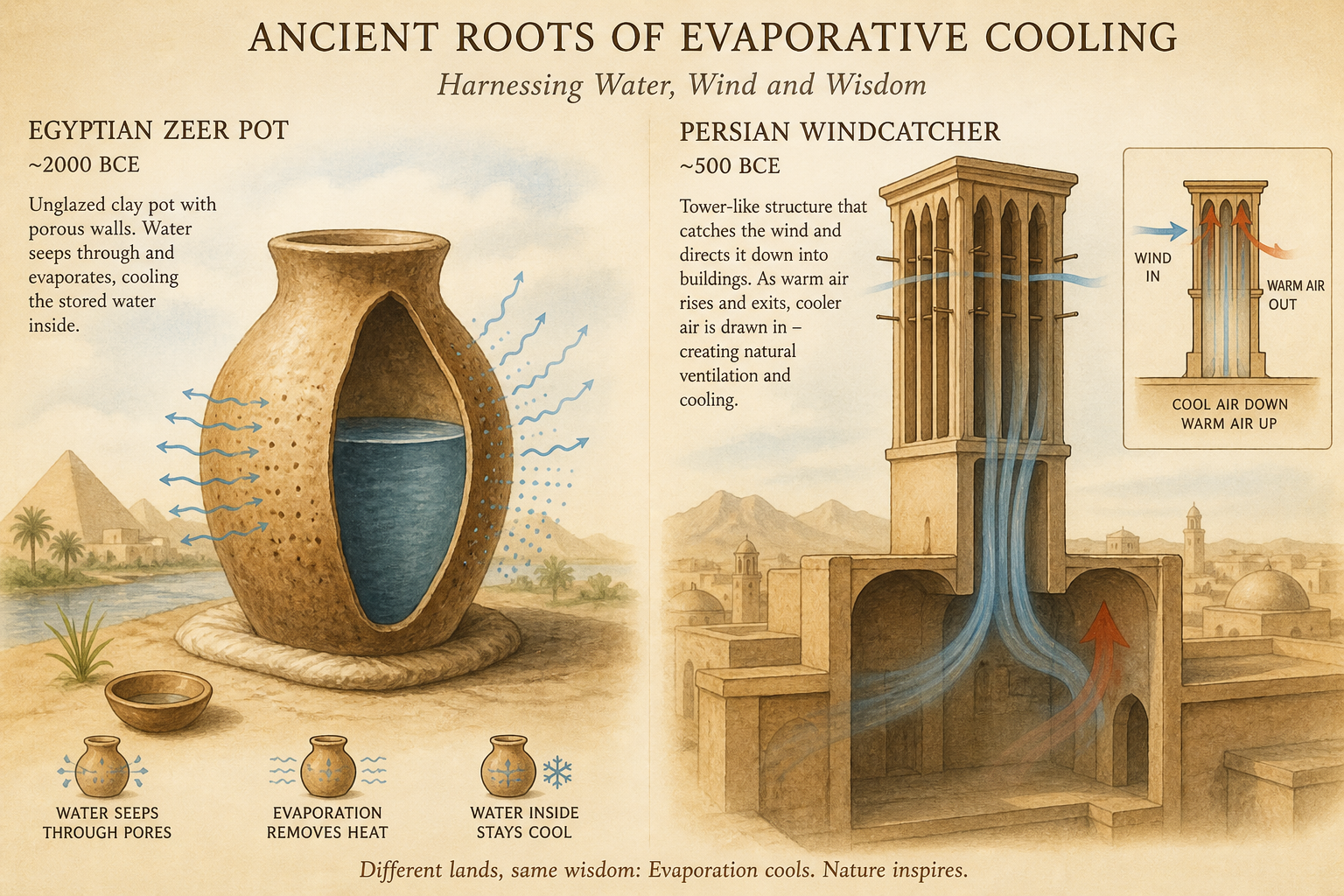
The Ancient Blueprint
Long before mechanical refrigeration, civilizations along the Nile were already exploiting the physics of phase change. The Egyptian zeer pot (~2000 BCE) paired two unglazed clay vessels with wet sand between them — water seeping through the porous terracotta walls and evaporating, pulling heat out of the inner chamber and keeping food and water cool in the desert heat.
A millennium later, Persian architects scaled the same principle to entire buildings with the badgir, or wind catcher — a tower engineered to funnel prevailing wind down into living spaces while drawing hot air up and out, creating a continuous, zero-energy ventilation cycle.
Every Aeon Terra sculpture is a direct engineering descendant of these two ideas.
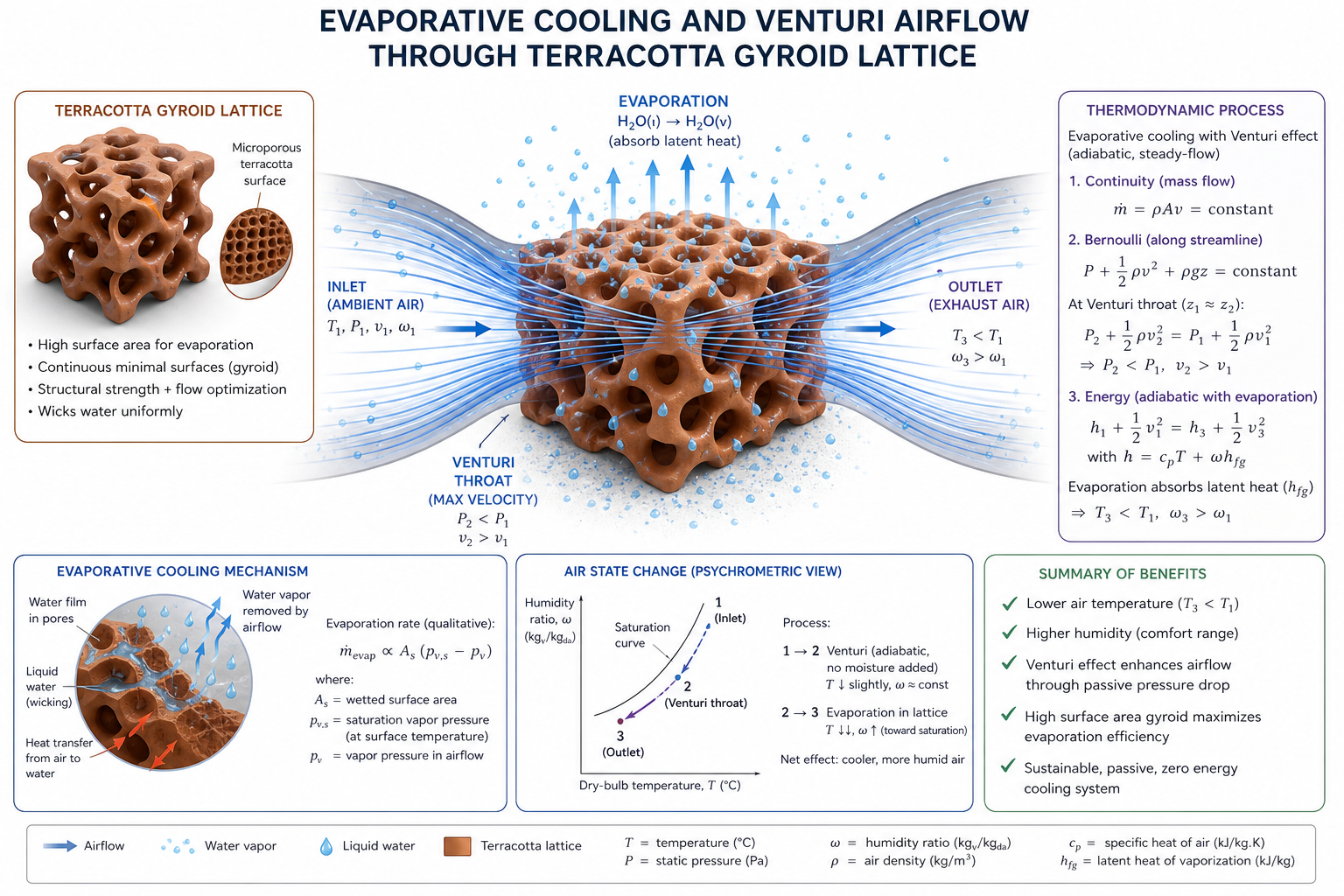
The Thermodynamic Physics
Evaporative phase change is the engine. Our unglazed terracotta body is fired to retain 20–30% natural microporosity. Water wicks through this open pore network via capillary action, and as it evaporates from the surface it absorbs latent heat directly from the clay — dropping surface temperatures by 8°F to 14°F without a single watt of electricity.
Venturi airflow does the rest. The internal gyroid lattice is a continuous, minimal-surface structure that narrows and widens the air path as it passes through — accelerating laminar room air into cooling micro-vortices that sweep moisture off the wetted surface faster than still air ever could.
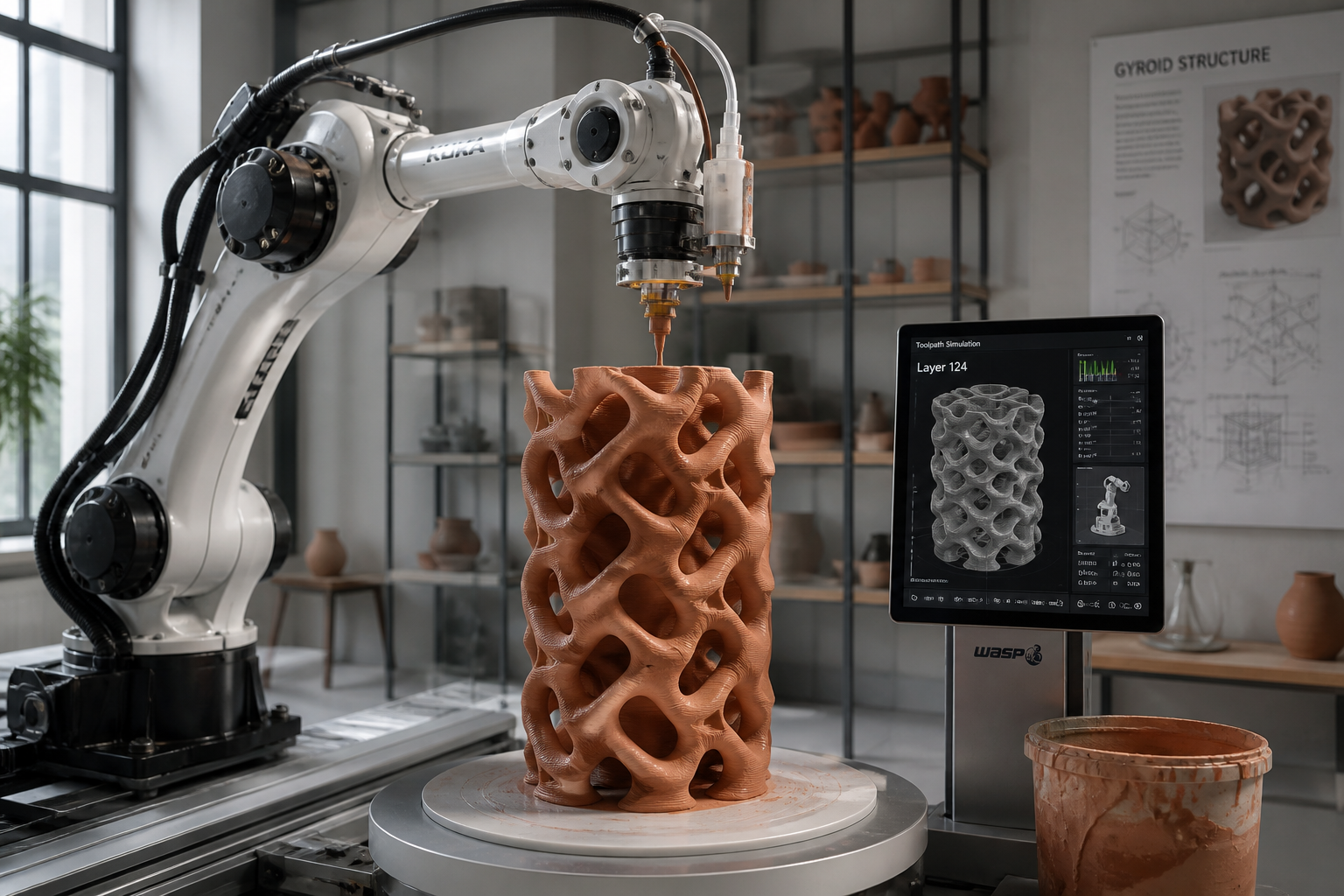
AI Meets Liquid Deposition Modeling
We translate that ancient physics into geometry no potter's wheel could ever throw. A generative AI mesh engine designs each form's gyroid lattice, Venturi ducting, and drip geometry to spec, then hands it to a six-axis robotic arm running Liquid Deposition Modeling (LDM) — extruding real wet clay, layer by layer, into shapes that are structurally validated before a single gram is printed.
Every sculpture is fired to a strict Cone 04 low-fire standard (1060°C), the precise vitrification ceiling that hardens the clay body while preserving the open microporosity the entire cooling effect depends on. Fire it hotter, and you get a beautiful, useless, fully-vitrified brick.
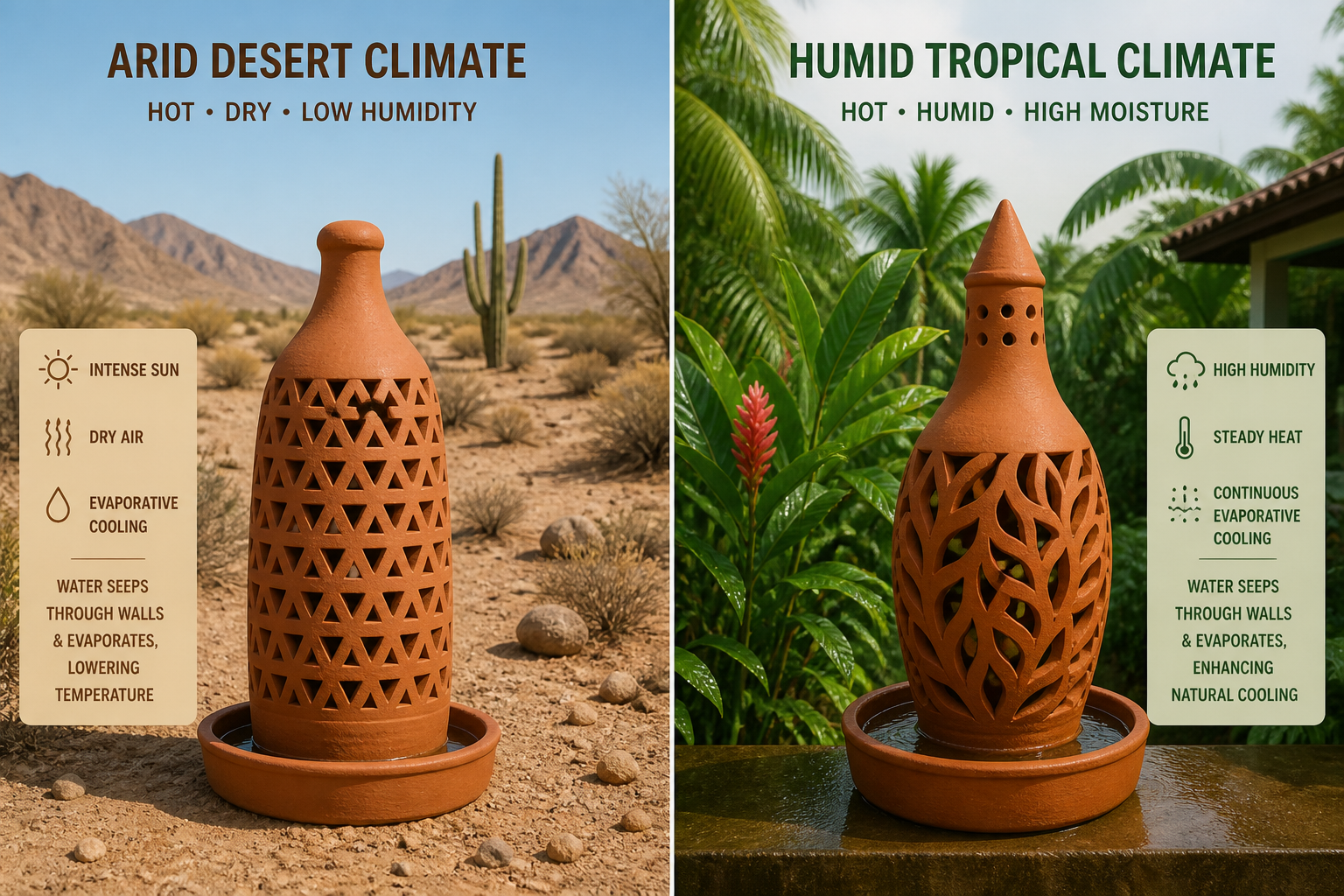
The Climate Adaptation Matrix
The same lattice physics resolve differently depending on where you live, so every Aeon Terra piece ships pre-tuned to a climate mode from our zip-code climate engine.
Maximum evaporative surface area exposed to dry air for the strongest possible cooling drop. Ideal for Phoenix, Denver.
Airflow tuned for biophilic purification over aggressive evaporation, since humid air is already near saturation. Ideal for Miami, Houston.
Two ways to put the physics to work.
Explore the Curated Collection
Eight pre-engineered, airflow-lab-validated geometries in fired terracotta, ready to ship from $149.
Browse CollectionsDesign in the Custom Studio
Upload a photo or describe your vibe, and let our parametric engine sculpt a one-of-a-kind piece tuned to your zip code's climate.
Open the Studio